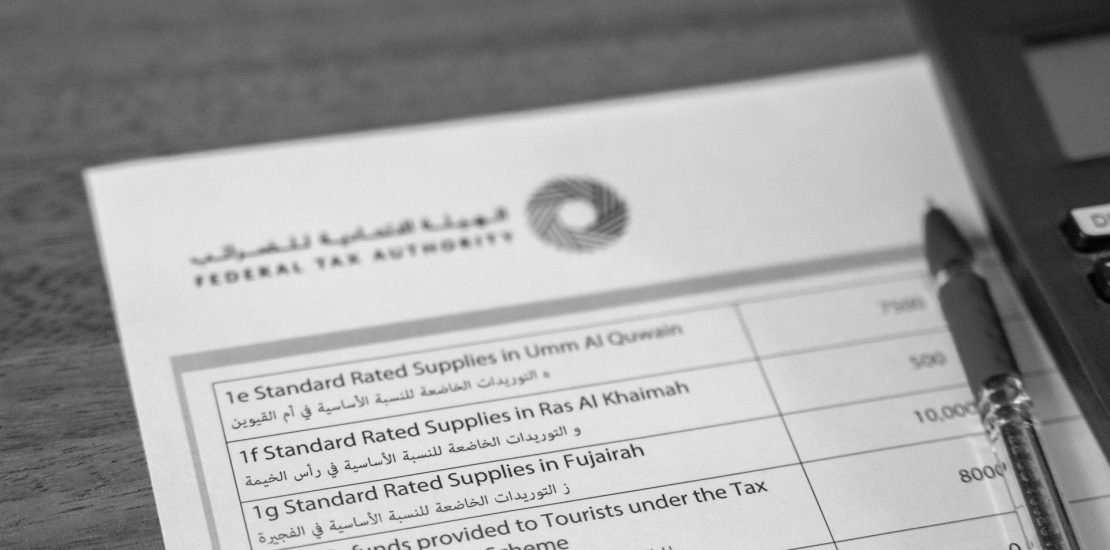
In the UAE, getting your tax invoice right goes beyond good bookkeeping because it is a legal obligation. Every VAT (Value Added Tax) registered business must issue compliant tax invoices for taxable supplies, and failure to do so can result in significant penalties from the FTA (Federal Tax Authority). With the country moving towards mandatory e-invoicing starting in mid-2026, the standards around invoicing are only getting stricter.
Whether you are running a small business in a free zone or managing an established mainland company, understanding what goes on a UAE tax invoice is important.
The Legal Basis: Where Do These Rules Come From?
UAE tax invoicing requirements are rooted in Federal Decree-Law No. 8 of 2017 on Value Added Tax and its Executive Regulation. Article 59 of the Executive Regulation is the primary provision that sets out exactly what a tax invoice must contain.
New amendments have introduced further changes to Article 59, specifically to prepare businesses for the transition to e-invoicing. Federal Decree-Law No. 16 of 2024 also amended the VAT Law to formally recognise electronic tax invoices as valid tax documents.
Full Tax Invoice: The Mandatory Fields
A full tax invoice is required for B2B (Business-to-Business) transactions where the recipient is VAT-registered, or where the total consideration for the supply exceeds AED 10,000.
Under Article 59 of the VAT Executive Regulation, a full tax invoice must include the following:
The words “Tax Invoice” clearly displayed on the document.
The name, address, and TRN (Tax Registration Number) of the supplier.
The name, address, and TRN of the recipient (where the recipient is a registrant).
A sequential tax invoice number, or a unique number that allows identification and sequencing of the tax invoice.
The date of issue.
The date of supply, if it differs from the date of issue.
A description of the goods or services supplied.
For each line item: the unit price, the quantity or volume supplied, the applicable VAT rate, and the amount payable expressed in AED.
The amount of any discount offered.
The gross amount payable expressed in AED.
The total VAT amount payable expressed in AED, together with the exchange rate applied if the original currency is not AED.
Where the supply falls under the reverse charge mechanism, a statement indicating that the recipient is required to account for the tax, along with a reference to the relevant provision of the Decree-Law.
Simplified Tax Invoice: When Can You Use One?
A simplified tax invoice is a lighter version of the full tax invoice. It is currently permitted in two situations: when the recipient is not VAT-registered, or when the recipient is VAT-registered but the consideration for the supply does not exceed AED 10,000.
A simplified tax invoice must contain the following:
The words “Tax Invoice” clearly displayed
The supplier’s name, address, and TRN
The date of issue, a description of the goods or services, the total consideration, and the VAT amount charged.
However, it is important to note that the role of simplified tax invoices is changing. Under the new e-invoicing framework, simplified tax invoice formats will no longer be permitted for businesses that fall within the scope of mandatory electronic invoicing. All tax invoices must be issued as full tax invoices, regardless of transaction value. Businesses should begin preparing for this shift now.
The Shift to E-Invoicing: What Is Changing?
The UAE is rolling out a national e-invoicing system based on the DCTCE (Decentralised Continuous Transaction Control and Exchange) model, using the international PEPPOL (Pan-European Public Procurement On-Line) framework.
The key dates businesses should note are as follows:
From 01.07.2026, the e-invoicing system will be operational on a voluntary, pilot basis.
From 01.01.2027, e-invoicing becomes mandatory for large businesses with annual revenue above AED 50 million.
From 01.07.2027, mandatory e-invoicing extends to all remaining VAT-registered businesses.
Under the e-invoicing framework, tax invoices must be generated in structured electronic formats (such as XML or JSON), transmitted through an ASP (Accredited Service Provider) approved by the Ministry of Finance, and reported to the FTA in near real-time.
Several current flexibilities will disappear once a business enters the e-invoicing scope. Simplified tax invoices will no longer be accepted. Administrative exceptions previously granted by the FTA for not issuing tax invoices or tax credit notes will cease to apply. Tax invoices will become mandatory for wholly zero-rated supplies, which were previously exempt from invoicing where sufficient records existed.
Penalties for Non-Compliance
The consequences of non-compliant invoicing are real and can add up quickly. Under the current framework, the penalty for failing to issue a tax invoice or tax credit note is AED 5,000 per missing document.
With the introduction of e-invoicing, the UAE has introduced a dedicated penalty structure. For failure to implement the e-invoicing system or appoint an ASP by the required deadline, a monthly penalty of AED 5,000 applies. For each electronic tax invoice or tax credit note that is not issued or transmitted on time, a fine of AED 100 per document applies, capped at AED 5,000 per month per category. Failure to notify the FTA of system malfunctions incurs a penalty of AED 1,000 per day. Failure to maintain required records for e-invoices carries a penalty of AED 10,000, which doubles to AED 20,000 for repeat violations within 24 months.
These penalties are cumulative. A business that delays system implementation, misses invoicing deadlines, and fails to report issues could face tens of thousands in fines within a very short period.
TME Services - Your Complete Business Partner
At TME Services, we help businesses in the UAE stay on top of regulatory and compliance requirements.
If you are unsure whether your tax invoices meet the FTA’s requirements, or if you want to get ahead of the e-invoicing transition, our team is here to assist.
Our comprehensive services are designed to support you every step of your business journey:
Company Formation: We guide you through all aspects of setting up your company, whether in a free zone or on the mainland, ensuring you choose the best option for your business.
Visa and Emirates ID Services: We streamline the process of securing visas and Emirates IDs for you and your employees, allowing you to focus on your business operations.
Accounting:Our team ensures your business stays compliant with local financial regulations, which is crucial for maintaining good standing in Dubai’s business community.
Tax: We help manage Dubai’s tax environment, ensuring your business remains compliant while optimizing your tax position.
Compliance and AML: We help ensure your business remains compliant with UAE laws and regulatory requirements while assisting in the implementation, maintenance, and training of AML (Anti-Money Laundering) procedures in line with national and international standards.
Business Consulting: Leveraging our deep understanding of Dubai’s market, we provide valuable insights and help you develop effective strategies to succeed.
Visit our services page to learn more about everything we do.