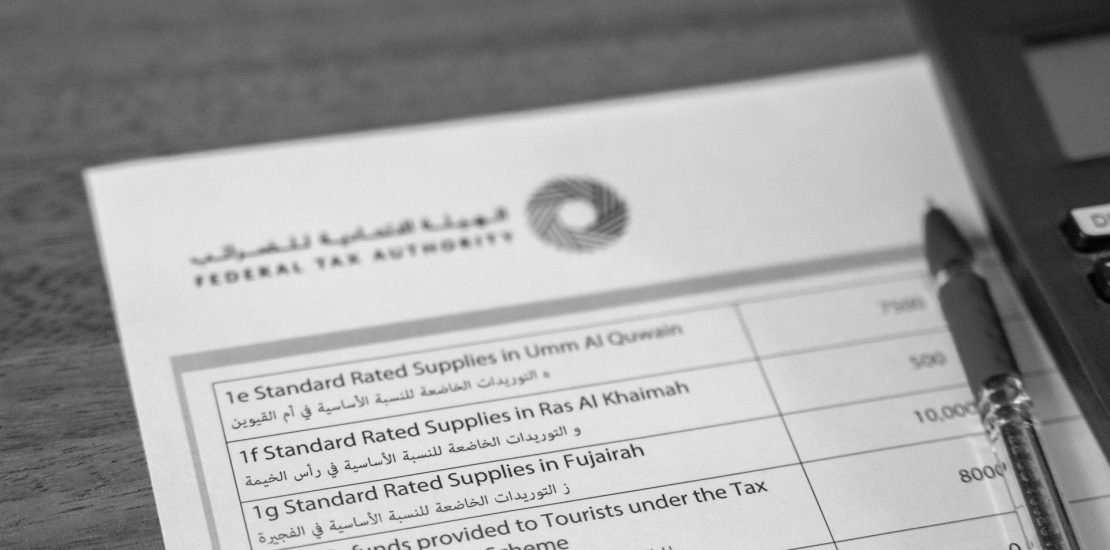
The penalties under the Tax Procedures Law apply across all tax types and cover the most common compliance failures.
Record-Keeping Failures
Businesses conducting taxable activities must maintain proper records as specified in tax legislation. Failure to do so attracts a penalty of AED 10,000 for the first violation. If the same violation occurs again within 24 months, the penalty doubles to AED 20,000. When the FTA requests documents in Arabic and the business fails to provide them, a separate penalty of AED 5,000 applies.
Registration and Deregistration
Missing the deadline to register for tax costs AED 10,000. On the deregistration side, late applications attract AED 1,000 per month, capped at AED 10,000. Failing to update your tax record when circumstances change carries a penalty of AED 1,000 for the first instance, rising to AED 5,000 for repeated violations within 24 months.
Tax Returns
Late submission of a tax return results in a penalty of AED 1,000 for the first occurrence and AED 2,000 for any repetition within 24 months. Submitting an incorrect tax return attracts AED 500, although this penalty does not apply if the registrant corrects the return before the filing deadline or submits a voluntary disclosure that does not change the amount of tax due.
Late Payment
This is where penalties become significant. Late payment of tax attracts a monthly penalty calculated at 14% per annum on the outstanding amount. The penalty begins from the day following the due date and continues monthly until payment is made. For voluntary disclosures and tax assessments, the due date for payment is 20 business days from submission or receipt respectively.
VD (Voluntary Disclosure)
The voluntary disclosure mechanism allows taxpayers to correct errors in tax returns, assessments, or refund applications. If a voluntary disclosure is submitted before the FTA notifies the taxpayer of an upcoming audit, the penalty is 1% per month on the tax difference, calculated from the day after the original due date until the disclosure is submitted.
However, if the taxpayer fails to submit a voluntary disclosure before receiving audit notification, the penalties increase substantially. A fixed penalty of 15% on the tax difference applies, plus the 1% monthly penalty. This structure creates a clear incentive: disclose errors early.
Tax Audit Non-Compliance
Failing to cooperate with FTA auditors as required under Article 20 of the Tax Procedures Law results in a penalty of AED 20,000. This penalty applies to the person being audited, their tax agent, or their legal representative, depending on who fails to provide the required facilitation.
Excise Tax Penalties
Businesses dealing with excise goods face specific penalties under Table 2 of the Decision.
Failing to display prices inclusive of excise tax costs AED 5,000. Not providing the FTA with price lists for excise goods produced, imported, or sold attracts AED 5,000 for the first violation and AED 10,000 for subsequent instances.
The most severe excise penalty relates to designated zone compliance. Failure to follow the conditions and procedures for transferring excise goods between designated zones, or for storing and processing such goods, attracts the higher of AED 50,000 or 50% of the applicable tax on the goods involved.
VAT Penalties
VAT-specific penalties under Table 3 cover invoicing, pricing, and designated zone compliance.
Failing to display VAT-inclusive prices costs AED 5,000. Not notifying the FTA when applying the margin scheme attracts AED 2,500.
Invoicing failures carry penalties of AED 2,500 per detected case. This applies to failure to issue a tax invoice within the required timeframe, failure to issue a tax credit note when required, and failure to comply with electronic invoicing requirements.
The designated zone penalty mirrors the excise tax provision: the higher of AED 50,000 or 50% of the applicable tax for non-compliance with goods movement and storage requirements.
Repeat Violations and Monthly Penalties
Several penalties in the Decision escalate for repeat violations within a 24-month period. Businesses should note that the clock starts from the date of the last violation, not from the original penalty notice.
For monthly penalties imposed on a specific date, the Decision includes a practical provision: if a particular month does not contain the corresponding date, the penalty falls on the first day of the following month. For example, if a monthly penalty is first imposed on 31.01, the February penalty would fall on 01.03 rather than 28.02 or 29.02.
Import-Related Penalties
Failing to calculate tax due on imported goods as required by tax law attracts a penalty of 50% of the unpaid or undeclared tax. This underscores the importance of proper customs and tax treatment at the point of import.
Legal Representatives
Where a taxable person has a legal representative, that representative carries direct responsibility for certain compliance matters. Failing to notify the FTA of their appointment within required timeframes costs AED 1,000, payable from the representative’s own funds. Similarly, if the legal representative fails to file tax returns on time, the AED 1,000 first-time penalty (or AED 2,000 for repetition) comes from their personal funds.
Objection Rights
The Decision preserves the right to object to penalties through the procedures established in Federal Decree-Law No. 28 of 2022 on Tax Procedures. If you believe a penalty has been incorrectly applied, the formal objection process remains available.